Private edge audit
Your strategy is not the question. Your evidence is.
Replay the market, journal the decisions, and inspect whether the edge survives a meaningful sample before you put more capital or another challenge behind it.
Real historical market replay Journal and strategy analytics No public proof required
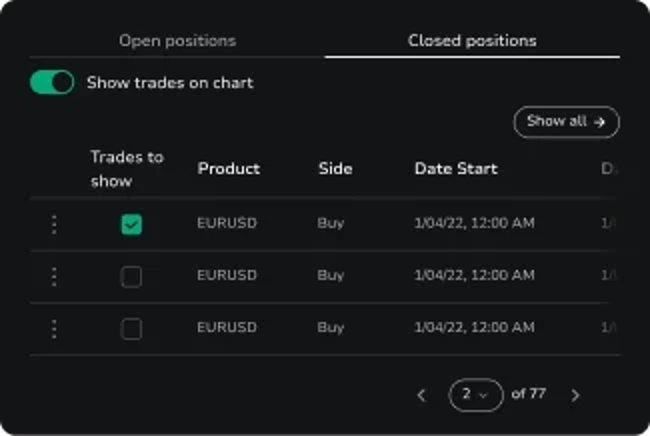
Sample109 trades
Expectancy+0.22R
Max drawdown-4.8R
Test coverage
- Canonical eyebrow
- Metallic H1/H2
- Responsive type
- CTA hierarchy
- Semantic surfaces
- Evidence table
- Rich text
- Interactive states
The private audit
Treat confidence like a claim that has to survive contact with data.
No lessons. No motivation. One repeatable process for deciding whether the setup deserves continued risk.01
State the claim
Define the setup, invalidation, market, and session before the replay begins.
02
Run the sample
Replay enough historical conditions to expose where the process holds and where it breaks.
03
Read the distribution
Review expectancy, drawdown, consistency, and sample size together instead of defending one result.
04
Make the decision
Keep the rules that survive. Revise or retire the ones that do not. No public explanation required.
Evidence, not identity
Inspect the distribution before you defend the strategy.
The same result can look convincing or fragile depending on the sample, drawdown, and conditions behind it.Expectancy+0.31RPositive across the reviewed sample
A weighted read of average wins and losses, not a win-rate badge in isolation.
Go directly to the decision point
Review the trade without losing the market context.
Use the chart, journal, and analytics together so one screenshot cannot become the whole argument.
Sample readout
The verdict changes when the context changes.
illustrative audit data| Condition | Trades | Win rate | Expectancy | Drawdown read |
|---|---|---|---|---|
| London trend | 42 | 57% | +0.31R | Within limit |
| New York open | 38 | 53% | +0.24R | Within limit |
| Range expansion | 29 | 48% | +0.08R | Variable |
| Combined sample | 109 | 53% | +0.22R | Review |
What the audit protects
A professional process can survive an honest answer.
The point is not to make every strategy pass. It is to stop weak evidence from borrowing confidence from your identity.Separate the process from the last outcome.
Review groups of trades, market conditions, and execution notes together. One clean win or one ugly loss cannot carry the verdict.
Private by default
Failed sessions remain data points you can inspect without turning them into public identity claims.
Statistical context
Expectancy, drawdown, consistency, and sample size belong in the same review.
Audit note
Write the thesis before opening the replay. If the rules change after every loss, the test is measuring your ability to rewrite the story, not the strategy.
- Keep the entry and invalidation explicit.
- Record the market context around each decision.
- Use
sample-sizeas part of the verdict.
Confidence should come from a process you can inspect, repeat, and explain.
Before the audit
Questions a serious trader should ask first.
The answers keep the promise narrow, private, and tied to historical evidence.No. This concept assumes you already know the setup and the vocabulary. The job is to audit whether the evidence supports the confidence you place in it.
No. The workflow is designed to be completed privately. Sharing is not required to get value from the replay, journal, or analytics review.
The page does not invent a universal threshold. The sample must be large and varied enough to test the written claim across the market conditions you expect the strategy to face.
No. Historical or simulated results do not guarantee future performance. The audit narrows uncertainty and exposes process risk. It does not remove market risk.
Historical evidence only
Stop defending the strategy. Audit it.
Run the setup through real historical markets, keep the work private, and let the sample tell you what deserves another round of risk.
FX Replay is a historical market backtesting tool. Simulated results do not guarantee future performance.